
SparkAI
.png)

_edited.jpg)


Spark the imagination with inclusive and alternative AI
In order to thrive and make positive change young people need AI literacy and a diverse set of AI skills. Spark AI offers just this, enabling teachers, pupils and students to develop essential AI technical abilities using fun and engaging educational AI tools:
-
Develop AI literacy through collaborative hackathon events for staff and students with PartyRock
-
Build interactive AI apps and develop vibe-coding applications with Playlab
-
Understand how to apply machine learning techniques and model movement data with micro:bit CreateAI

AI won't take your job, it's sombody using AI that will take your job
Richard Baldwin, Economist

Playlab AI
Playlab is a purpose-built platform for teachers to design their own safe, classroom-ready AI tools: instant writing feedback, a Socratic tutor, or a lesson-planning sidekick that actually knows your curriculum. It's built with equity and safety front and centre, so you can hand it to students knowing moderation methods and safeguards are in place.
The perfect tool for students to create their own bespoke AI apps; shaping prompts, testing outputs, and learning first-hand where the guardrails are (and why they're there).

PartyRock AI
PartyRock is a free AI app-building playground developed by Amazon. Educators can put together a custom AI tool (a subject tutor, a dataset detective, a wildly enthusiastic creative writing coach) in the time it takes to make a coffee, then bring it straight into the classroom.
Several fun features allow you to enjoy bespoke AI chatbots, image generators and in browser data analysis.
micro:bit createAI
Take AI and Machine Learning off the screen and into young people's hands, literally! Using the micro:bit's built-in sensors, students train their own AI models on real, physical data (their own movements, tilts, taps) and see the results instantly on a tiny wearable computer. It's a full, hands-on AI lesson that brings AI and coding to life while turning abstract ideas like bias, accuracy, and data collection into something students can literally shake, wave, and debug in real time.
.jpg)

National Education Nature Park AI and Biodiversity KS3 Unit of Work
This is a set of six lessons designed to get your students talking about biodiversity and nature while also helping them understand how artificial intelligence (AI) works, its benefits and drawbacks. Learners will begin by using digital tools to learn about biodiversity in the UK, while being encouraged to consider how AI can aid or harm learning. They will then be introduced to the concept of machine learning (ML) and how it can assist with solving real-world problems. Learners will then have an opportunity to grapple with some of the ethical issues around AI, before creating their own biodiversity study in the final two lessons.

Attend certificated, face-to-face AI training suitable for all primary and secondary teachers. Covering principles of AI and how to master a variety of educational AI tools. These events take place in London, Oxfordshire, Hertfordshire and Buckinghamshire.

Join certificated, online bite-sized professional development opportunities on topics such as Playlab, AI in education and AI and physical computing. Build your confidence of using AI for impactful teaching and learning.
.jpg)
Workshops (face-to-face)
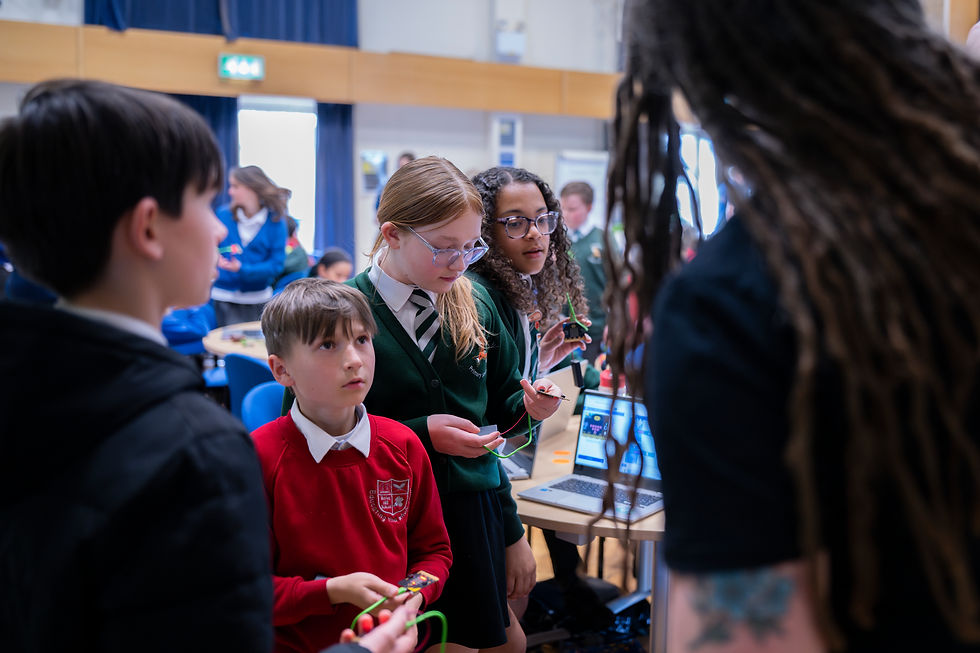
Delivered in your school by experienced computer science teachers, available across England. Equipment including Chromebooks can be provided during the workshops
Resources
Access free, adaptable learning materials, lesson plans, and classroom activities designed to integrate AI into your curriculum.
Online CPD
Upcoming Events
 Alternative AI03 Nov 2026, 16:00 – 17:00Online
 Build Classroom-Ready AI Tools with Playlab09 Nov 2026, 16:00 – 17:00Online
 Spark AI: Ignite your classroom with inclusive and alternative AI12 Nov 2026, 10:00 – 14:30Rutherford Appleton Laboratory, Harwell, Campus, Chilton, Didcot OX11 0QX, UK
 micro:bit AI: KS201 Dec 2026, 16:00 – 17:00Online
 Unlock micro:bit AI07 Dec 2026, 16:00 – 17:00Online
 Meet the New Amazon AI Tool PartyRock08 Dec 2026, 16:00 – 17:00Online
 Alternative AI07 Jan 2027, 16:00 – 17:00Online
 AI in Education12 Jan 2027, 16:00 – 17:00Online
 Build Classroom-Ready AI Tools with Playlab28 Jan 2027, 16:00 – 17:00Online
In Person Events
Teacher Training:
Full and half-day courses will be available at locations throughout the country.
Pupil Festivals:
Bring your Year 4, 5 or 6 pupils to a fun, inspiring and active day of Astronaut Fitness activities with the micro:bit and CreateAI
Resources

AI and Biodiversity - KS3 Scheme of Work
Go beyond general AI education; this scheme of work embeds AI education in real world application allowing students to see what AI is and how it can be part of future careers as well as getting hands on with AI.
A set of six lessons designed for Key Stage 3, co-developed with National Education Nature Park will get your students talking about biodiversity and nature while also helping them understand how artificial intelligence (AI) works, its benefits and drawbacks.
Learners will:
-
Use digital tools to learn about biodiversity in the UK,
-
Be encouraged to consider how AI can aid or harm learning.
-
introduced to the concept of machine learning (ML) and how it can assist with solving real-world problems. grapple with some of the ethical issues ar
-
Create their own biodiversity study in the final two lessons.
Learners will investigate biodiversity and the issues threatening nature in the local area and the UK through internet research with and without an artificial intelligence tool. Learners will evaluate the experience of each process and consider the positives and drawbacks of using AI like this.
Start by looking at some of the data being collected by schools in the National Education Nature Park. Learners then develop their understanding of ML and its subtypes and start to think about what tasks or questions different types of machine learning might be suited for. Learners then revisit the Nature Park data they looked at and consider what type of machine learning might suit the data.
Introduce learners to three methods of machine learning. They will then use the ML for Kids site, to try out the different methods. Learners reflect on their experience with each model.
In this lesson, learners will explore some of the ethical issues surrounding the use of AI and engage in a debate. They will also have a chance to train and use an image recognition model to identify animals and see the effects of bias in training data.
Learners design an enquiry into a biodiversity-related question that will use AI/ML. Learners can draw on data from Nature Park or from external sources for their project. Suggested sources for biodiversity information can be found in the lesson plan.
In this final session, learners should carry out their enquiry. Learners then answer questions about their enquiry and evaluate its effectiveness. Finally, learners fill in the self-evaluation of skills at the end of their work journal.
Why not join our teacher AI WhatsApp group?
